
User-Verified Inputs
All values are entered or explicitly confirmed by the user before any decision is made.
The therapy is the same. Access to decision support is not.
Transparent, deterministic, user-controlled logic for people using injections — and the clinicians who define their therapy.
All values are entered or explicitly confirmed by the user before any decision is made.
Meal and correction support built on configured therapy parameters and visible assumptions.
No automatic insulin delivery, no autonomous therapy, and no hidden system behavior.
Parameter-driven logic that reflects how clinicians already define insulin therapy.
An estimated 50-65 million people worldwide use multiple daily injections (MDI), and most do not have access to integrated, high-resolution decision support. For many, dosing remains manual, approximate, and cognitively demanding.
Diabetes management requires repeated decisions under real-world conditions. For people using injections, those decisions are often made using simplified rules or mental estimation applied throughout the day.
Some tools provide partial support, such as carbohydrate-based tables, but typically do not incorporate real-time blood glucose, correction logic, or a consistent framework for applying therapy parameters.
The therapy model is the same. The execution model is not.
Clinicians define therapy using parameters such as carbohydrate ratios, correction factors, and target glucose levels. In pump-based care, those parameters are applied directly. In injection-based care, they are often translated into simplified rules that patients must apply manually.
This creates both structural and cognitive burden, and introduces a gap between clinical intent and day-to-day execution.
BolusLabs removes this translation layer. It provides harmonized, single-source-of-truth decision support across clinician configuration (BolusView) and patient execution (BolusGuide).
The result is consistent, transparent, user-controlled dosing support aligned with how insulin therapy is actually defined.
Sources: International Diabetes Federation (IDF) Diabetes Atlas, World Health Organization (WHO) – Diabetes
Even with clinician support, many dosing decisions still depend on simplified rules, paper-based guidance, and repeated user interpretation.
Around meals, users must interpret guidance, estimate, and adjust—often repeatedly throughout the day.
BolusLabs is designed around safety, transparency, and real-world use.
The system is designed with a security-first mindset, emphasizing controlled inputs, predictable behavior, and protection of user data throughout the calculation process.
The architecture reflects experience in regulated software environments, where traceability, validation, and system boundaries are critical to safe operation.
The founder brings more than three decades of personal experience managing diabetes, informing both the design decisions and the focus on reducing daily cognitive burden.
A deterministic calculation flow with explicit user control at every step.
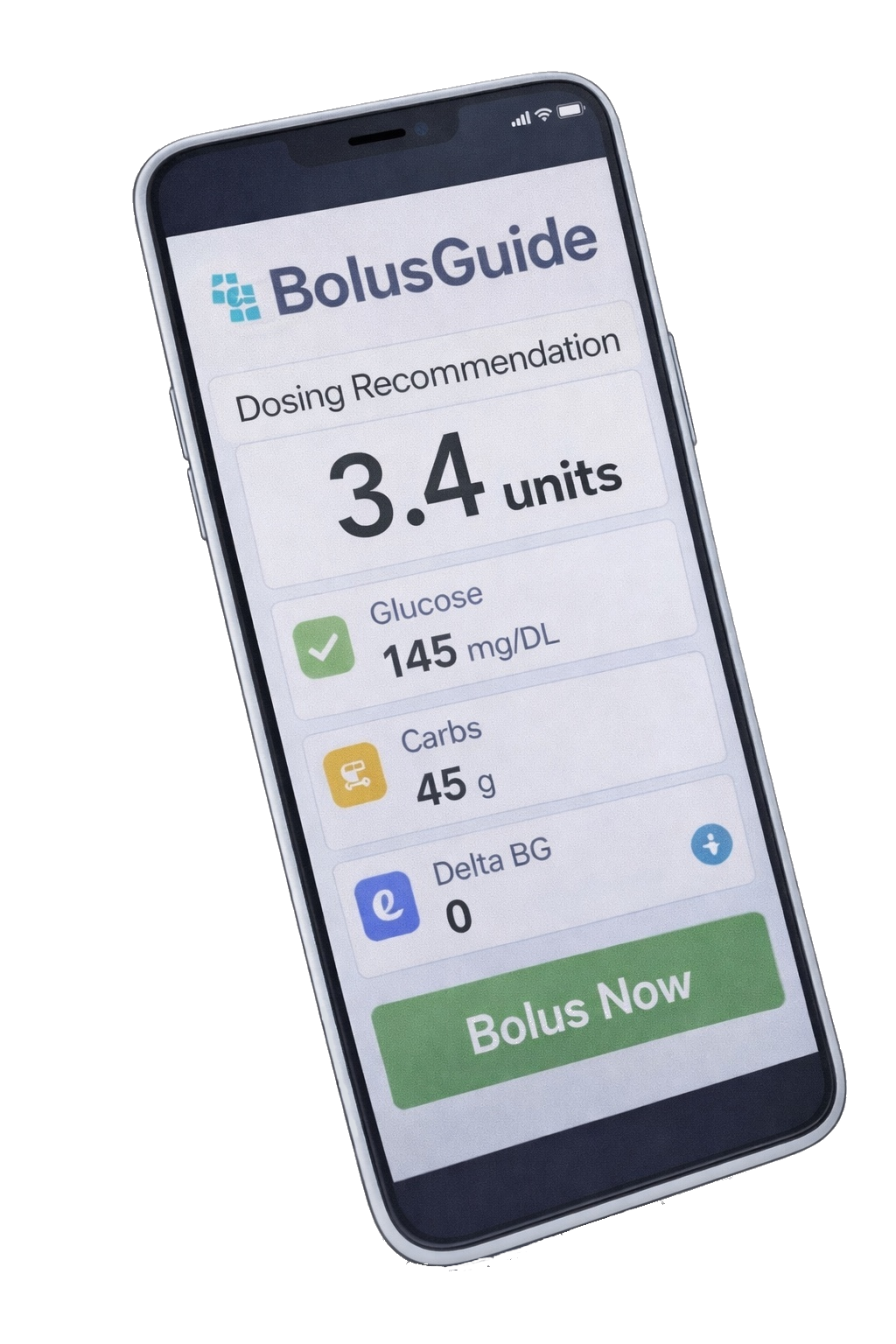
The user enters or confirms relevant values such as blood glucose and carbohydrate intake. All inputs are explicitly user-controlled.
The system applies configured therapy parameters to estimate meal and correction dosing. All logic is transparent and consistent.
The recommended dose is presented for user review. No automatic dosing occurs, and all decisions remain under user control.
BolusGuide is designed for real daily routines—helping users move from repeated estimation toward structured, consistent insulin dosing decisions.
Around meals and corrections, users need fast, clear, and reliable decision support—without giving up control.
Every recommendation is visible, explainable, and confirmed by the user.
BolusView is designed to support review of dosing patterns and facilitate structured therapy discussions over time.
Structured data and deterministic logic enable more consistent therapy discussions and adjustments over time.
The clinician layer supports decision quality over time without introducing automated therapy.
BolusGuide is built around deterministic logic, explicit user control, and clear system boundaries—ensuring that every decision remains transparent and user-driven.
All inputs are manually entered or explicitly confirmed by the user. The final dosing decision remains with the user.
Configured therapy parameters, visible assumptions, and explainable outputs form the basis of the system.
No closed-loop control, no automated insulin delivery, and no autonomous therapy behavior.